Through Play, Psychiatry Fellows Provide Counseling for Children at School
by Laura Castañón
There are only about 11,000 child and adolescent psychiatrists in the entire United States, according to the American Academy of Child and Adolescent Psychiatry. Even in places where providers are available, many hurdles can get in the way of care – finding a doctor who accepts the right insurance, taking children out of class, or missing work to bring kids to daytime appointments.
Melinda Macht-Greenberg, a psychologist on faculty at Tufts University School of Medicine and in the Eliot-Pearson Department of Child Study and Human Development at Tufts University, wanted to make it easier for parents to access psychiatric care for their young children. She reached out to her colleagues at Tufts Medical Center, and developed a training rotation that brings fellows from the Child and Adolescent Psychiatry program directly to the Eliot-Pearson Children’s School.
It’s the only training rotation in the Boston area that gives psychiatrists the opportunity to work with preschool-aged children within the context of a classroom.
“It has been enormously successful,” said Macht-Greenberg, who is also a consulting psychologist for the Eliot-Pearson School. “We are bringing care to the kids in their environment, where they’re most comfortable, where they feel safe and secure, while also training and teaching the future generation of child and adolescent psychiatry.”
During their first year, the fellows—who have already completed four years of medical school and four years of general psychiatry training—visit the Children’s School once or twice per week for three months. They work with children individually, spend time interacting both in the classroom and on the playground, and consult with teachers and parents. They also find time to meet with Macht-Greenberg on site to discuss strategies and continue their training to learn about play therapy with young children.
“When you’re immersed in the school, you see the child and their strengths. We can see how to build and support a child with the flux of their day, which is a unique opportunity that many people in the clinical world don’t get.”
- Melinda Macht-Greenberg, a psychologist on faculty in the Eliot-Pearson Department of Child Study and Human Development
“I think this rotation helps the fellows pivot and use different skills than they normally do,” said Neha Sharma, director of the fellowship program, vice chair of the Child and Adolescent Psychiatry division at Tufts Medical Center, and associate professor at the School of Medicine. “Getting experience in a non-clinical setting, where they’re sitting on the floor and talking to one kid about one specific toy, pushes our fellows to learn and grow. My job is to equip them to be the best child psychiatrists and those moments are really meaningful.”
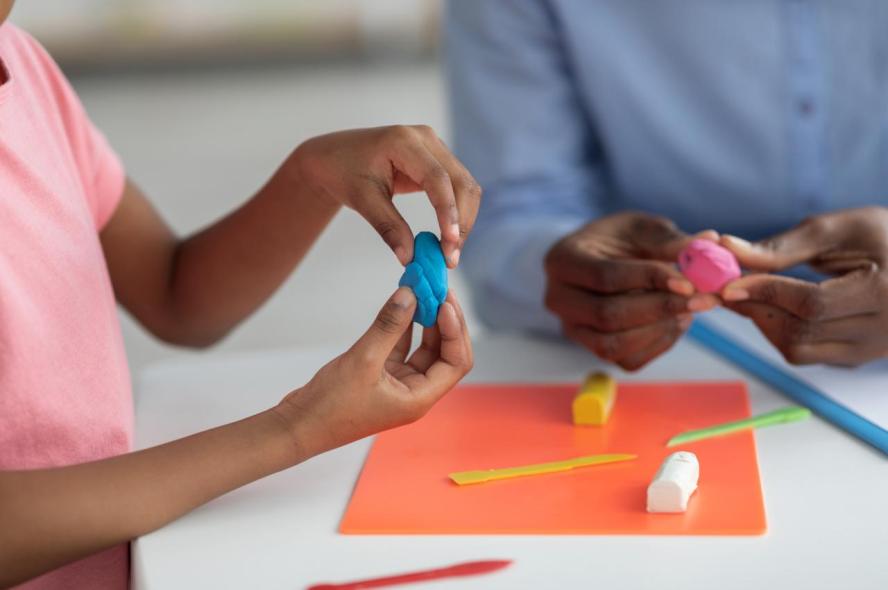
Unlike older adolescents or adults, young children do the majority of their learning through play. The fellows—who the children call ‘play doctors’—help kids work through challenges using toys, games, art supplies, and imagination. This allows children to take a step back from their own problems by pretending that, for example, a doll is experiencing the issue instead of themselves.
“Play therapy with young kids helps them learn how to process information, how to process their environment, and how to manage their emotions,” Sharma said. “It gives coping skills at an early age that can help them throughout their lives.”
Because these sessions happen at the school, it’s easy for fellows to connect with teachers and create a network of support for students. The fellows can tell teachers what they’re working on with a particular student and provide suggestions for how to continue those efforts. Or the teachers can give fellows a heads up about specific skills with which a child is struggling.
Additionally, the fellows have the opportunity to observe social interactions in the classroom and on the playground. They get a better understanding of what child development looks like at this age—typical development can cover a wide spectrum—and how to support it.
“Play therapy with young kids helps them learn how to process information, how to process their environment, and how to manage their emotions. It gives coping skills at an early age that can help them throughout their lives.”
- Neha Sharma, associate professor at Tufts University School of Medicine
“When you’re immersed in the school, you see the child and their strengths and how we can build on their strengths to help them be able to cope or problem solve around the things that are challenging,” said Macht-Greenberg. “We can see how to build and support a child with the flux of their day, which is a unique opportunity that many people in the clinical world don’t get.”
The rotation has only been in place for a year, but by all accounts, it has been incredibly successful. Some parents have even requested to continue working with a specific ‘play doctor’ through their clinical practice in the child psychiatry division of Tufts Medical Center.
“It’s a win-win-win from everybody’s perspective,” said Macht-Greenberg. “The parents have been pleased and impressed. The teachers are noticing very positive changes. The kids are doing really well. And the fellows report that they have gained not just skills in working with young children, but also a much stronger understanding of early development.”
Macht-Greenberg, Sharma, and their colleagues are looking into how to expand this type of care in the future. They hope to be able to grow their efforts and further support kids in their development.
“We’re trying to figure out how can we do more, how can we take this to the next level and extend it to the larger community,” Sharma said. “We don’t have those answers yet, but we know we’re doing something that’s rewarding and that’s working.”