A World Without TB? John Green Says It’s Overdue
Many Americans believe tuberculosis is an historic relic, said Ramnath Subbaraman, an associate professor at Tufts University School of Medicine who studies the disease. “TB? Is that still going around?” is a common question he gets.
Despite being the world’s deadliest infectious disease, killing more than 1.2 million each year, TB remains out of sight and out of mind in many developed countries.
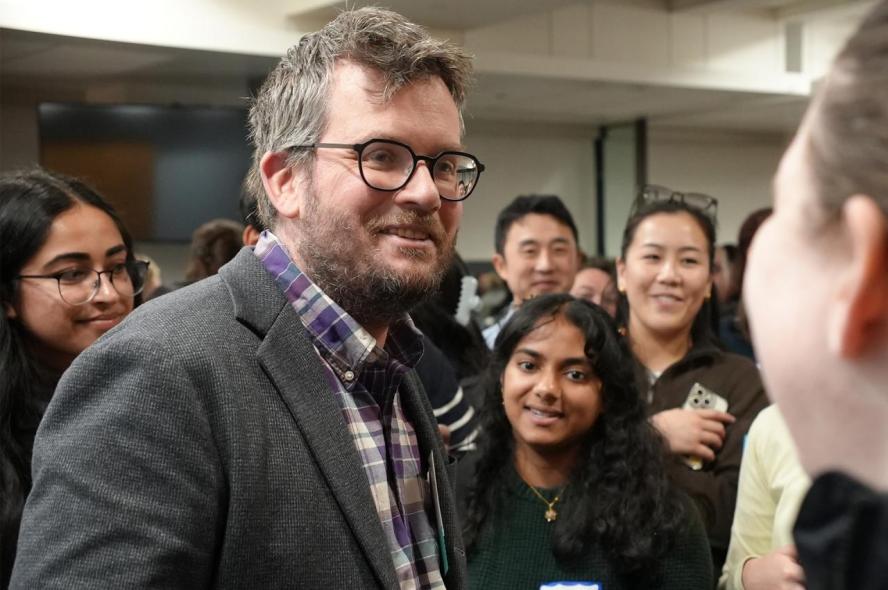
That is one reason Subbaraman was thrilled when author John Green accepted his invitation to speak at Tufts about his instant bestseller Everything Is Tuberculosis, which has helped raise public awareness of the disease.
Green is perhaps best known as the author of young adult novels, including The Fault in Our Stars, a heartrending story about two teenagers with cancer who fall in love. His latest work is a nonfiction tale of a different malady, but even without a romance, it calls up strong emotions as it delves into the science of tuberculosis and our public health successes, failures, and inequities in combating it.
Everything Is Tuberculosis was this year’s selection for the Common Book Program for incoming medical students, a partnership between the School of Medicine and the Jonathan M. Tisch College of Civic Life.
On Feb. 4, many of those students joined a packed auditorium on the Boston health sciences campus as Green spoke with Helen Boucher, dean of the School of Medicine, about his book and his advocacy. The event was hosted by the Dr. Maurice S. Segal Lecture Series and Tisch College’s Solomont Speaker Series with additional support from the Tufts Center for Global Public Health and the TUSM Global Health Faculty Council.
Here are a few takeaways from Green, whom Subbaraman called “the best thing to happen to TB.”
Exciting new tests and treatments for TB are emerging. The shame is that we could have conquered TB decades ago.
“We’re at another inflection point with TB, where there are better tools coming,” Green said, noting “game changing” tongue swab tests that are more sensitive than current tests but cost only a fraction of their price, and even potential vaccines.
“We’re seeing new medicines, thanks in part of your research,” he said, acknowledging the infectious disease scientists in the audience, “so that [multi-drug resistant] TB may not be the same level of crisis in a person’s life that it is today.”
As promising as the advances are, “what’s disheartening to me is that we’ve known how to cure this disease since 1955, and we choose not to cure it,” he said. We could have been at this point 30 years ago “if we were pouring resources into TB and treating it as the size of problem it is,” he said.
Since pharmaceutical companies do not see a lucrative market for TB drugs, Green said, it will take government investment, patent buyout, and other strategies to drive progress.
Green’s own experiences with OCD made him sensitive to the stigma of tuberculosis.
“I was really reluctant to talk about it for a long time because it’s personal and it felt embarrassing,” Green said of his chronic illness. But sharing how he copes “has done some good on the front of my own self-stigmatization.”
Like mental illness, TB is highly stigmatized, Green said, describing patients who’ve had their medication thrown to them across the room because the person dispensing it was afraid of catching the disease. Whether it’s because of a lack of personal protective equipment or misinformation of how TB is spread, such treatment is dehumanizing.
A provider’s actions and words can deeply affect a patient, as Green discovered when he was hospitalized for meningitis. As he lay semi-conscious, he heard the doctor say, “I don’t think he’s going to die.”
“What the hell?” Green thought. “Is that on the menu?”
Whatever the condition, Green said, “the way we talk to people living with illness really does matter.”
Health care worldwide is rife with inequities. But there is reason to be hopeful.
“There are forces that would further the dehumanization of others, whether those are immigrants or unhoused people or people who are just living lives different from what is considered to be the norm,” Green said.
But from a wider perspective, we’ve come so far. He noted that 200 years ago, half of kids died before the age of five. Some 25 years ago, it was 11 million, and this year, it will be fewer than 5 million.
“That’s the greatest achievement in the history of our species,” he said, which gives him hope. “There is reason to believe that when people decide collectively that we’re going to value the lives of children, that we actually can make progress on that front.”
If the same value could be put on people living with malnutrition, HIV, or tuberculosis, Green said, “then we would dramatically be able to shift the arc of the story of those diseases.”