Connecting Classrooms, Clinics, and Continents
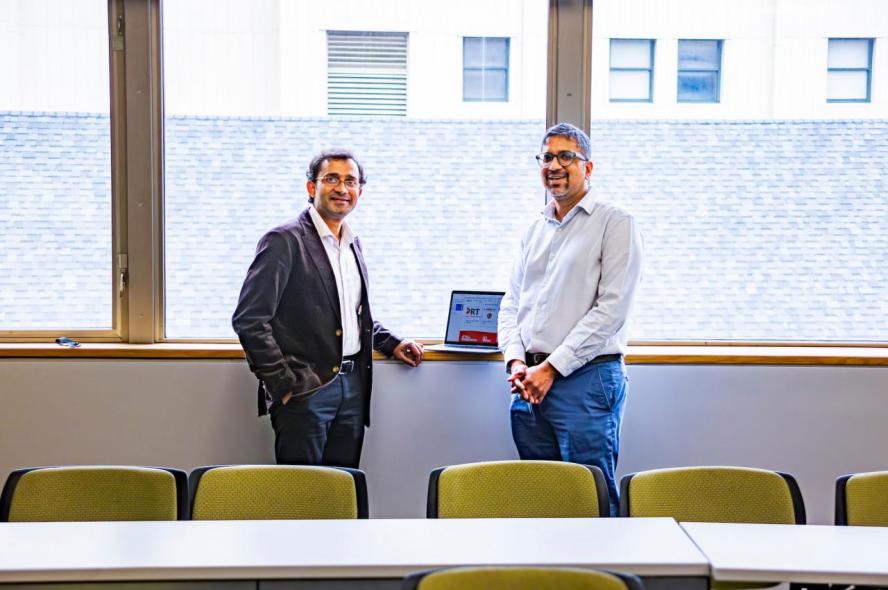
Jaya Prasad Tripathy heals not just people, but healthcare. A physician and public health scientist at the All India Institute of Medical Sciences in Nagpur, India, he focuses on tuberculosis research and treatment in low-and middle-income countries, and initiatives to strengthen health systems across the globe.
As such, Tripathy is particularly interested in implementation science, which is the study of how to translate research findings into real world practice. But while the field is critical to improving health outcomes, it is still emerging in India, leaving relatively few opportunities for advanced training and mentorship.
Enter Ramnath Subbaraman, also a physician and public health researcher who is focused on tuberculosis and how healthcare is (or isn’t) delivered, in India and across the world. Subbaraman also teaches implementation science as an associate professor at Tufts University School of Medicine, an ocean away from the All India Institute. Despite the distance, his expertise in implementation science and his focus on tuberculosis made him a natural fit for Tripathy's training goals.
For Tripathy, whose passion is bridging gaps—patients and care, research and the real world—the solution was simple: the Indian Council of Medical Research International Fellowship Program, which sends early- and mid-career scientists to train at leading institutions abroad for a few months to a year.
The program is competitive, selecting just a handful of scientists from across many universities, medical institutions, and disciplines. But Tripathy was determined. “This was an opportunity for me to learn the concepts, the theories, the frameworks—and their application in real-world problems,” he said.
Tripathy reached out to Subbaraman, whom he knew through mutual colleagues. “There was interest on Tufts’ side as well in being a site for the fellowship and engaging with scholars who might want to come,” Subbaraman said.
Together they crafted an application laying out clear and ambitious goals around training, research, and participation in Tufts’ academic community, and as a result, were selected for the fellowship.
When Tripathy landed in Boston in the fall of 2025, he hit the ground running and has been immersed in a packed schedule of learning, teaching, and (of course) implementation ever since. Weekly meetings with Subbaraman have helped Tripathy refine his research approach and expand his methods, he said. “I’m learning a lot from Dr. Subbaraman’s experience.”
Tripathy has not just attended Subbaraman’s course on implementation science, but also contributed practical insights to classroom discussions, drawing on his experience leading operational research training across multiple countries.
“His perspectives add a lot to the learning environment—he brings a wealth of real-world experience that complements the theoretical material,” Subbaraman said. “It’s been really wonderful to have him in the course, almost like having another faculty member there. He’s been just as enriching to our community, as he’s been gaining from being here.”
Tripathy also delivered an introductory lecture for fellow implementation science students, seminars centering on infectious diseases and public health and community medicine, and one of the School of Medicine’s Global Health Seminars. He has even spoken at other institutions in the Boston area and attended online forums on other researchers’ projects. “I’ve met many researchers working in similar domains. It’s been good networking with them, and a wonderful learning opportunity,” he said.
Tripathy has also completed an intro course in the Department of Public Health and Community Medicine in spatial epidemiology, which examines the geographic distribution of diseases to understand how they spread, and an advanced course in the topic on the Medford campus. “The field has always interested me, and I always wanted to learn more about it,” Tripathy said.
And he has already begun using the methods he has learned on a large dataset of tuberculosis patients from India—more than 2,400 cases from a single district. “We are jointly analyzing that dataset,” Tripathy said. “Not just learning, but also applying that knowledge.”
Having submitted two papers, the pair are working on several more. And although Tripathy returned to the All India Institute in June to apply what he has learned and teach it to others, he and Subbaraman are already dreaming of joint research projects and academic initiatives in the future.
“There’s hopefully longer-term collaborations that could emerge out of this, and opportunities for both of our institutions to benefit,” Subbaraman said.
Department:
Public Health and Community Medicine