Taking the Pathogen’s Perspective
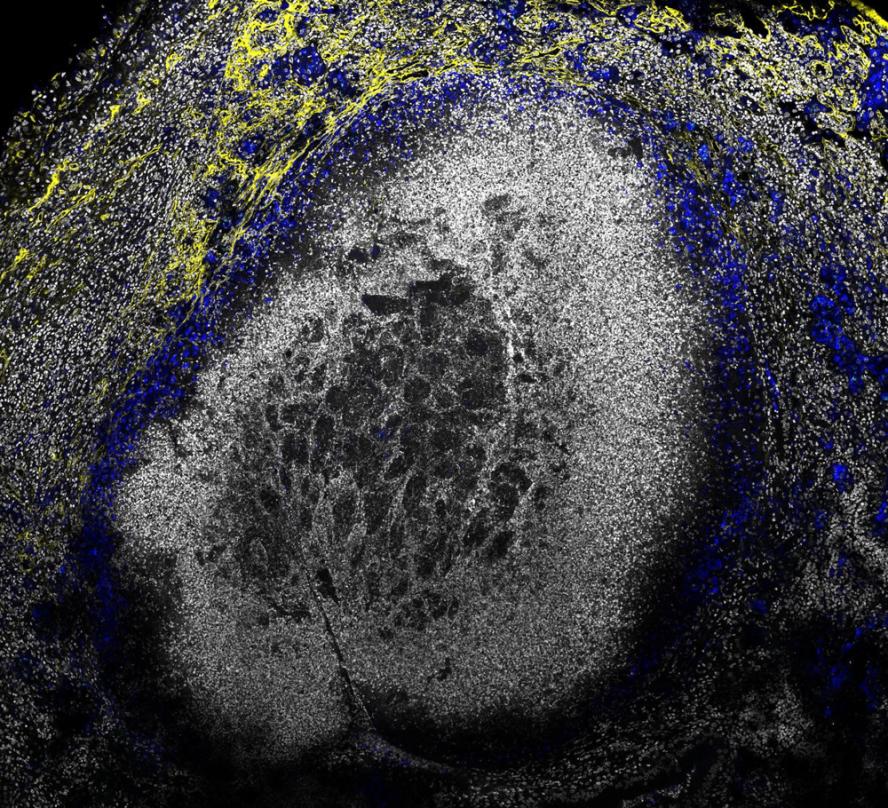
Tuberculosis has afflicted humanity for thousands of years, remaining the single deadliest infectious agent and a leading cause of death overall.
Mycobacterium tuberculosis (Mtb), the pathogen that causes tuberculosis, is striking for its variability across locations within a host’s lung. Most research into this spatial variation has focused on the host’s response to infection. But a recent study from the lab of Shumin Tan, associate professor of molecular biology and microbiology at Tufts University School of Medicine, has found success approaching the problem from the pathogen’s perspective.
Tuberculosis persists in part because of Mtb’s ability to adapt to changing environmental conditions, sacrificing rapid growth to weather the host’s immune response. This longevity and differentiation make clearing Mtb difficult, often requiring multiple treatments.
Tan’s research is guided by a question that at first appears simple: how does Mtb know when it has reached its target—an appropriate cell or location in the lung in which it can survive?
“Once Mtb has entered the host, it is bombarded by all of these environmental signals simultaneously and it somehow has to figure out how to integrate all of this information into one adaptive output,” Tan said.
Her most recent study, published in Science Advances, identified specific ways Mtb responds to different environmental conditions by looking for changes in the pathogen’s gene expression.
“Our approach was predicated on the fact that we know Mtb’s adaptation to a given environment is driven by changes in gene expression,” Tan explained, “so we can use changes in gene expression as a proxy for what it's ‘seeing’ in the host.”
Researchers typically track gene expression by developing strains of “reporter” bacteria for each of the various genes or groups of genes they are interested in. This process can be time- and resource-intensive and is even more difficult when applied to long-lasting infections like tuberculosis, as the reporter systems can be lost with time.
Alternatively, scientists can use harsh chemicals to break through a pathogen’s membrane and access its genetic information. But these chemicals also destroy host tissue, and in doing so lose key spatial information about where exactly the bacterium lives.
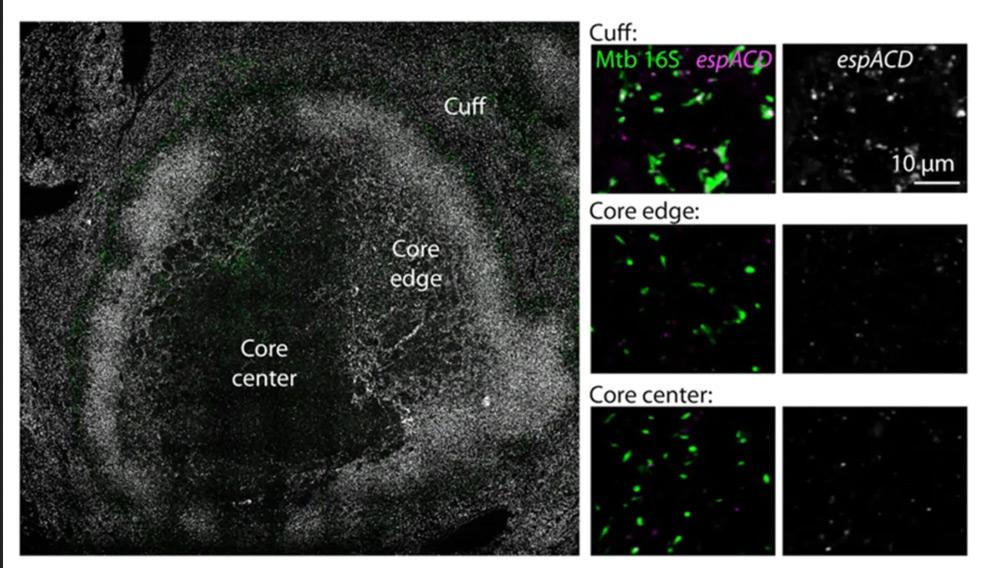
Over the past few years, Tan’s lab has meticulously figured out how to penetrate Mtb’s cell envelope layer by layer, developing a detailed protocol for probing Mtb gene expression while keeping host tissue intact. Using this technique, the researchers have mapped Mtb’s gene expression over the space and time of a tuberculosis infection. In this study, they followed three key aspects of Mtb adaptation: its lipid metabolism, its response to specific environmental stresses, and its expression of components of a structure Mtb uses to export proteins through its complex cell envelope.
In response to an infection, host immune cells attempt to wall off Mtb, forming lesions called granulomas. The outer layers of these lesions are formed of immune cells called macrophages and neutrophils. As more immune cells are called in to fight the infection, a core of dead cells forms inside the lesion. These dead cells provide Mtb with a bounty of lipids to use as nutrients, but lesion formation also alters the environmental stresses to which Mtb must adapt.
The researcher’s new method of visualizing Mtb gene expression in intact lung tissue has allowed them to identify corresponding changes in Mtb lipid metabolism, adaptive stress response, and its protein secretion system at different locations within lesions.
With a method for probing Mtb gene expression in hand, Tan’s lab hopes to assess additional environmental conditions and directly analyze how these differences track with Mtb adaptation and growth. For example, there are different types of lesions that form in tuberculosis as well as subtypes of the immune cells found in these lesions. The lab aims to understand how these immune cell subtypes present different environments for Mtb. This future research is being funded by a grant from the G. Harold and Leila Y. Mathers Foundation that was recently awarded to Tan.
Citation: Lawrence AE, Tan S. Direct bacterial transcript visualization illuminates spatiotemporal environmental adaptation of Mycobacterium tuberculosis in the lung. Sci Adv. 2026;12(33):eaeb8377. doi: 10.1126/sciadv.aeb8377.
Department:
Immunology