Their Future Is Now: Fourth-Year Medical Students Match With Residencies
by Saima Sidik
Photography by: Alonso Nichols
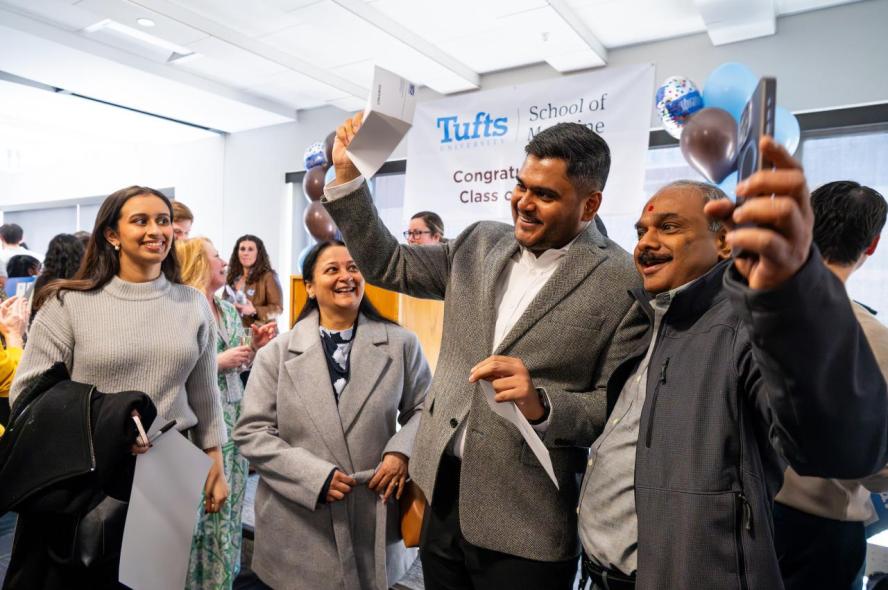
Every year, fourth-year medical students around the U.S. complete an intense round of applications and interviews for residency programs. With those steps complete, the National Resident Matching Program feeds the students’ preferences and their future employers’ preferences into an algorithm that determines where the students will perform their residencies—a career phase during which they’re considered full doctors, but also still learning from more senior doctors.
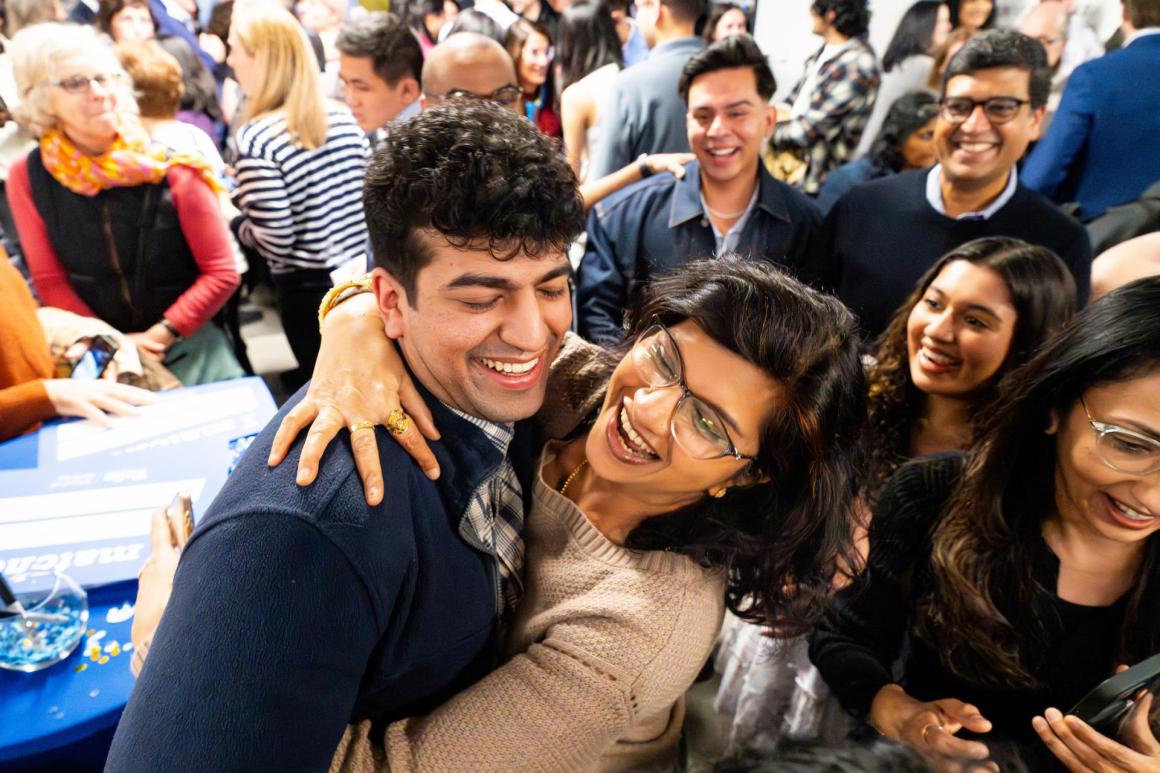

The matching process is exhilarating and often nerve wracking. Today, 194 Tufts University School of Medicine students matched with residencies, with 19 at Tufts Medical Center and 13 at Maine Medical Center. About 20% of Tufts medical students matched with Tufts-affiliated hospitals.
Here, four doctors-to-be at Tufts School of Medicine reflect on the journeys that brought them to this transition point between students and physicians.
Sammi Bottom-Tanzer, Aspiring Oncologist
Together, the members of a string quartet communicate seamlessly and produce something more meaningful than one person ever could alone, says Sammi Bottom-Tanzer. Growing up, she thought music would be the language she’d use to express herself, too. She studied violin intensely, even attending a boarding school focused on music, then training with a professor from The Juilliard School during her bachelor’s degree.
Instead, Bottom-Tanzer intends to become an oncologist. But while the subject matter is different, medicine encompasses the same shared vision as music, she says. “Everyone is working together to make something beautiful, to help their patients do what they love. I think that’s what appeals to me so much about this career path.”
The inspiration for Bottom-Tanzer’s switch from music to medicine came during her undergraduate degree at Columbia University, when she worked in a lab that was co-run by a medical doctor and a PhD scientist. “I loved how they pushed back against each other’s ideas, wrestled with experiments, and together asked such impactful and clinically relevant questions,” she says. Bottom-Tanzer is following in both her mentors’ footsteps as a student in Tufts' joint MD/PhD program. Students in the program complete the first two years of medical school, then a PhD, then finish out the program with the third and fourth years of medical school.
For her PhD, Bottom-Tanzer worked in the lab of Chris Dulla, chair and Annetta and Gustav Grisard Professor of Neuroscience at the School of Medicine, where she studied traumatic brain injury in a mouse model. The brain is constantly switching states, whether you’re paying attention, watching a movie, or walking. Her research revealed that the injured mouse brain is disproportionately altered during certain behaviors. Applying this finding to human brain imaging could allow physicians to better understand how a patient’s injury impacts them during different behaviors and tasks.
Eventually, Bottom-Tanzer would like to combine research and clinical work, but first she faced the dilemma of choosing which field of medicine to go into: “Throughout third year, I enjoyed every single one of my rotations, so I had a lot of trouble deciding,” she said.
Working at a clinic for patients who’d had extended stays in the ICU helped her decide. Solving these patients’ complex physical and cognitive problems required a highly interdisciplinary approach, which brought Bottom-Tanzer back to that feeling of making music with other people. The experience motivated her to go into the highly interdisciplinary field of internal medicine, and eventually to sub-specialize in oncology.
Her interest in oncology was also sparked by personal experience: Bottom-Tanzer’s husband has thyroid cancer, and helping him navigate his care has shown her just how big a difference it can make when a doctor understands the mindset of a patient and their support people. She says, “doctors care so much for their patients, but it’s different when you’re looking out for your person. Hopefully my patients will benefit because I’ve experienced that.”
Sammi's match: Massachusetts General Hospital. “What a privilege to take my next step in becoming a physician here. To stay near our friends and family and for my husband to continue with his incredible care team means the world. We couldn’t be more grateful.”

Owen Doane, Aspiring Pediatrician
First-year psychology class is a rite of passage for many college students, but for Owen Doane, the course changed his life. When the professor turned to neuroscience, he remembers thinking, “that is really interesting. I could thrive doing a major that connects behavior to the psychology of the human experience.”
So Doane became a neuroscience major at the University of Michigan. He thought he might like to apply his knowledge to medicine, so after college, he found a job as a medical assistant at a community health center in his hometown of Portland, Maine. The clinic largely served refugees seeking asylum, and the patients didn’t always understand the health center’s administrative systems.
Doane remembers one day when a mom showed up with four of her children when only two were scheduled for check-ups. Doane’s supervisor didn’t even hesitate before saying, “‘well, there are four kids here, so we’re going to do four check-ups.’ She didn’t even need to pull up their charts to know their entire medical histories,” he says. Seeing how an understanding, engaged doctor can put an entire family on a healthier trajectory solidified his decision to pursue medicine as a career.
Doane also knew how he wanted to train to be a doctor: via Tufts School of Medicine’s Maine Track program. This collaboration between Tufts and Maine Medical Center graduates about 40 students each year with the goal of keeping as many as possible in Maine, where physicians are in short supply. Students spend their first year in Boston with the rest of the medical school class, but from their second year on, they spend all their time learning in Maine.
Doane was drawn to the program because it gave him the opportunity to be part of a tight-knit group of medical students while staying in a community he loves, and because he thinks Maine’s physician shortage is a serious problem he’d like to help solve. From a financial perspective, the scholarships he and other Maine Track students received helped him manage the cost of medical school.

Fiona Beltran, Aspiring Surgeon
As the daughter of a contractor and a cake decorator, Fiona Beltran grew up appreciating the value of hands-on work. “As a first-generation college student, my parents could not guide my academics, but they taught me hard life-skills that I continue to carry with me today,” she says.
But it was Beltran’s older brother, who has an intellectual disability, who inspired her to go into medicine. Growing up, Beltran was struck by how much her brother’s disability impacted his understanding and autonomy over his health. From an early age, Beltran accompanied her brother to medical appointments, and she noticed that providers often excluded him when making medical decisions instead of involving him in deciding his care.
Now Beltran practices with the understanding that it’s critical for physicians to take verbal and nonverbal cues into account so that they can provide patient-centered care for those with disabilities. This approach embodies her mindset toward medicine, and not just for people with intellectual disabilities.
“I’m a champion for any underserved patient,” she says. Her priorities show in the research she conducted during medical school, for which she investigated how to help people with intellectual and developmental disabilities cope with obesity.
Beltran’s not just a champion for patients—she also wants to bring more Hispanic women like herself into the surgical field. A 2022 study found that only 2.4% of physicians in the U.S. are Hispanic women, “and that’s crazy!” she says. “Being underrepresented makes me want to be a great mentor to all types of people because mentorship has been a huge part of getting me to where I am today, and I want to give the same support to other people.”
Beltran has worked with Cornelia Griggs, a pediatric surgeon, since her preclinical years and identifies her as an unwavering pillar of support through her medical journey.
For her residency, Beltran pursued a couples match with classmate Charley Sun, who she started dating when they were first-year medical students. Their early relationship was a bit unconventional, as many of their conversations took place over cadavers in anatomy lab. But it’s been invaluable to have a partner who understands the demanding nature of medicine, Beltran says. She and Sun both know their surgical training will demand more of their time than they can ever imagine, but they balance this demand by finding “little pearls” throughout the day, like catching up over a five-minute coffee or chatting briefly between cases at the hospital.
For her residency, Beltran is pursuing general surgery with the hope of eventually sub-specializing in either pediatric or trauma surgery. She says, “I love pediatrics because you get to reassure patients and their families. But I also find trauma medicine interesting because research in this field influences policy decisions that shape daily life and promote safer communities.”
Fiona's match: Yale in general surgery
Charley Sun, Aspiring Surgeon
For Charley Sun, A22, practicing medicine is all about forming relationships with patients. So it’s perhaps unexpected that he started his medical career as a clinician whose interactions with patients are fleeting: an EMT.
From his second year of undergrad through his first year of medical school, Sun worked for Armstrong Ambulance in Medford, Massachusetts. Even though he was often responsible for patients’ care for only a matter of minutes, those minutes could be some of the most distressing in a person’s life, and Sun was often the sole provider helping them through it.
“I learned that I love the trust and vulnerability that comes with that relationship,” he says. Today, Sun is planning to become a trauma or cardiothoracic surgeon, and part of the reason he chose that field is because he hopes to help patients through the similarly difficult time surrounding their decision to undergo surgery.
During medical school, Sun researched the factors that have an impact on heart surgery outcomes with Yong Zhan, a cardiac surgeon and associate professor at the School of Medicine. Technology has progressed over the last ten years to a point where doctors can sometimes replace an aortic valve through minimally invasive means rather than having to open up a person’s chest, but unfortunately not everyone has equal access to these techniques. “Minority groups often face more barriers to timely access of newer procedures. I think that’s an important topic to highlight and address,” he says.
Sun is a double Jumbo, having also earned his bachelor’s degree in biopsychology at Tufts. Throughout his years at the university, he’s found time to unwind by playing water polo. He was captain of the Tufts team during his senior year, and since graduating, he’s been playing in a recreational league called the Boston Wet Sox. “We play at a local YMCA, and it’s been a fantastic way to stay engaged in a team sport,” he says.
As he nears the end of medical school, Sun has sometimes found himself working at the same hospitals he used to bring patients to as an EMT, but this time his interactions with patients are far more sustained. He’s looking forward to forging even deeper bonds with patients during surgical residency, but going through the couple’s matching process with another aspiring surgeon has definitely been “both exciting and nerve wracking,” he says.
Surgical residencies typically take five to seven years, or even nine for doctors who sub-specialize, as he and Beltran both plan to do. Because they expect the next step in their training to take nearly a decade, Beltran and Sun have a strong preference for matching to hospitals that are close to each other — not a small ask given that surgery programs tend to be very small and competitive.
But having a fellow aspiring surgeon with whom to navigate this stressful stage of training has been invaluable, too. “Fiona and I bring out the best in each other,” Sun says.
Charley's match: Yale in general surgery