Meet the Tufts MPH Faculty: Real-World Expertise, Research, and Teaching in Action
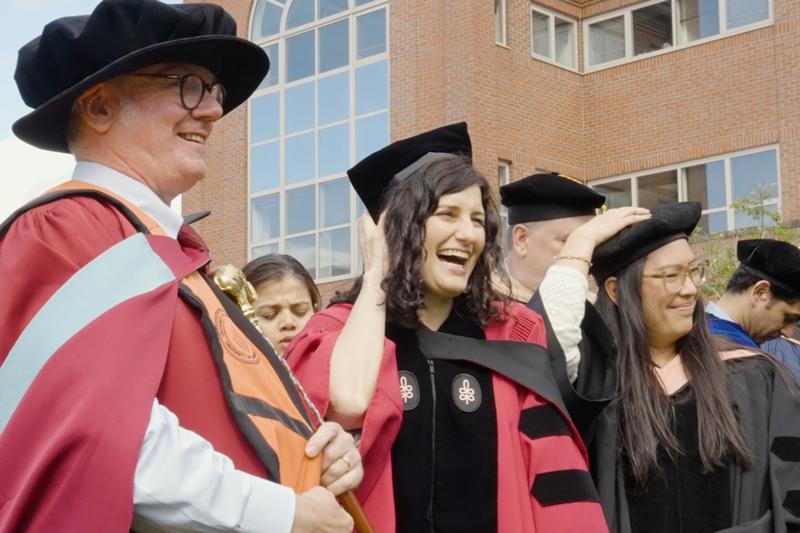
Choosing a graduate program is not only about curriculum—it is about the people who will guide your learning, shape your thinking, and mentor your professional growth. One of the defining strengths of the Tufts MPH program is its faculty: educators, researchers, and practitioners whose work extends far beyond the classroom.
Tufts MPH faculty bring deep real-world experience into their teaching. Many have worked in public health departments, federal agencies, healthcare systems, community organizations, and global health initiatives. Their expertise is grounded not only in research, but in practice—connecting policy, community engagement, clinical systems, and population health in ways that make learning both rigorous and relevant.
In these short videos, Tufts MPH faculty share their areas of expertise, research focus, and professional journeys. Together, these stories reflect a core philosophy of the Tufts MPH program: that public health education should be connected to real communities, real challenges, and real impact.
Ndidiamaka Amutah-Onukagha
Dr. Amutah-Onukagha’s work centers on advancing Black maternal health through research and community-based initiatives addressing maternal health disparities, reproductive justice, infant mortality, and HIV/AIDS among Black women.
Olaf Dammann
Dr. Dammann's work integrates epidemiology and philosophy. In philosophy, his area of interest is causal inference and etiological explanation.
Saloni Dev
Dr. Dev’s research advances global mental health by studying the social and structural drivers of mental illness and scaling community-based, evidence-driven interventions through implementation science in under-resourced settings worldwide.
Kimberly Dong Breen
Dr. Kimberly Dong Breen’s work centers on nutrition and food security as drivers of health equity, with community-based research addressing healthcare access, HIV prevention, justice-involved populations, Asian American health, and community health worker–led interventions.
Karen Errichetti
Dr. Errichetti’s work focuses on program evaluation, public health informatics, and community-centered implementation of healthcare innovations, advancing equitable, data-driven decision-making in historically underserved communities.
Jonathon Gass
Vanessa Nicholson Robinson
Dr. Nicholson Robinson’s work advances maternal and nutritional health equity by translating research into policy, systems change, and community-centered interventions that address racial inequities in maternal health and reproductive care.
Silas Pearman, III
Dr. Pearman’s research focuses on public health and exercise science, with an emphasis on health promotion and physical activity.
Michael Siegel
Dr. Siegel's research examines alcohol, tobacco, and firearms through the lens of corporate influence on health, with a recent focus on structural racism and racial inequities in health.
Margie Skeer
Dr. Skeer’s research focuses on family engagement and family meals as strategies for preventing adolescent substance use and other risk behaviors.
Thomas Stopka
Dr. Stopka’s research uses community-engaged epidemiology to examine the intersection of substance use, infectious diseases, and opioid overdose among high-risk populations and to develop interventions that reduce health disparities.
Ramnath Subbaraman
Dr. Subbaraman’s research applies implementation science and community-based approaches to improve tuberculosis care, adherence, and health equity in India.
Alice Tang
Dr. Tang’s research examines nutrition, metabolic health, and interventions among people living with HIV globally, with a recent focus on health disparities in Asian American and Pacific Islander communities.
The faculty of the Tufts MPH program represent the full scope of modern public health—spanning research, policy, practice, education, and community partnership. Their work reflects a shared commitment to training students not only to understand public health systems, but to engage with them meaningfully and ethically.
For students, this creates a learning environment where education is connected to lived experience, research is grounded in real-world impact, and mentorship is rooted in care, rigor, and professional development. Learning at Tufts means learning from people who are actively shaping the field—locally, nationally, and globally.
If you are considering an MPH, these faculty perspectives offer a clear picture of what makes the Tufts experience distinctive: a community of scholars and practitioners who care deeply about their students, their communities, and the future of public health—and who are committed to preparing the next generation of public health leaders through education that is applied, compassionate, and purpose-driven.
Related Links: