Bridging Research, Education, and Clinical Practice with Tufts DPT-Atlanta Faculty Member Craig Wassinger
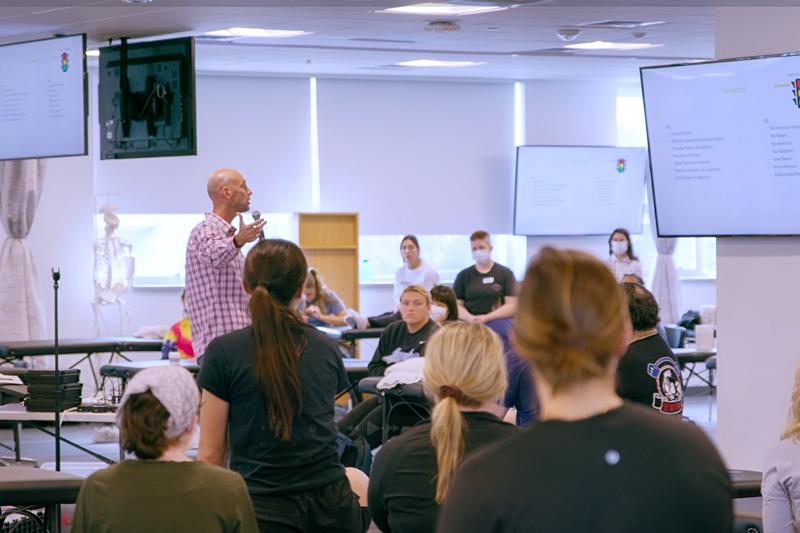
As Director of Research and Faculty Development and Professor in the Tufts Doctor of Physical Therapy Atlanta program, Craig Wassinger, PT, PhD, brings a unique perspective that spans clinical practice, teaching, and research. Throughout his career, he has focused on advancing the understanding of musculoskeletal pain and shoulder rehabilitation while helping shape the next generation of physical therapists. In this spotlight, he shares insights on the evolution of pain science, the importance of lifelong learning, opportunities for student engagement in research, and emerging innovations that may transform patient care.
What inspired you to pursue a career that combines physical therapy, teaching, and research, and how have those interests evolved over the past 20 years?
"I am, for better or worse, not very good at doing any one thing, which is why I think I enjoy doing all of these things. I initially wanted to be a physical therapy educator, as I was inspired by some of my professors in PT school. As I learned more, I quickly grew to appreciate that you cannot separate these things, and that improvement in one area can help across all areas. I think I have evolved over time to intentionally focus on growth across all of these areas."
Your research focuses on musculoskeletal pain and shoulder rehabilitation. What questions are you most interested in exploring, and why are they important to patients and clinicians?
"I chose these areas of study because they were the most challenging for me to comprehend as a clinician. I chose to lean into these perceived weaknesses to help myself, and hopefully my patients, improve. As I learn more about pain, my research has become less focused on the shoulder and more focused on the person with the shoulder. This was initially challenging for me because I had spent so much time studying the details of the shoulder, but it has opened my eyes to how treatments can work for patients across a range of conditions. The intersection of pain and shoulder, or any joint, mechanics is interesting to me. If clinicians can take this lens of applying what they know about anatomy and biomechanics and overlap it with what is known about pain, that is someone I'd want to treat me or my family. I see clinicians separating these areas, whereas I feel they should be combining them."
Pain science has become an increasingly important part of physical therapy education. How has our understanding of pain changed during your career, and how does that influence the way future physical therapists are trained?
"Pain has shifted from a tissue-specific model, where pain is linked to a specific injury, toward a biopsychosocial model, where pain is complex and has many dimensions that contribute to it. At the same time, our understanding of how pain is initiated, produced, and alleviated or maintained has expanded greatly. These two concepts should impact the way clinicians consider pain. Historically, PT were only trained based on a tissue-specific model. Treatment concepts have expanded to include the newer understanding of pain and work to better address holistic components of person and the way the body responds to pain. The challenge has become training educators and clinicians on these newer concepts so they can be included in PT education and reinforced in clinical education and professional practice."
As Director of Research and Faculty Development, how do you foster a culture of scholarship, innovation, and evidence-based practice within the Tufts DPT program?
"I work to promote a culture of ongoing growth by modeling these behaviors and supporting faculty in their growth. My director role helps support faculty in areas where they would like to grow. As such, I work with everyone to identify ways they would like to improve, and use my experience and knowledge of resources to support them in this process. This can include things such as direct mentorship, connecting faculty across campus, leveraging Tufts' many resources, identifying training opportunities, and so on. The range of roles required of clinical faculty members allows plenty of chances to continue to learn and embody the goals of the DPT program."
What opportunities do DPT students have to engage with research and scholarly inquiry during their time at Tufts?
"Tufts DPT uses an accelerated, hybrid program model. Within this, students are trained in evidence-based practice and clinical reasoning, using research to support all aspects of clinical practice. There is specific coursework to this end, and the application of research is highlighted across our program. There is no requirement for students to perform research, as this is a clinical professional degree, yet some students have taken steps beyond their coursework and contributed to faculty-led projects. We are working within our program to provide research opportunities to interested students as part of their education through selective coursework. I would love to see this implemented to reinforce students' evidence-based knowledge and support students who may include research in their careers after PT school."
What recent developments in physical therapy research are you most excited about, and how do you see them shaping the future of rehabilitation and patient care?
"There are so many interesting advances in PT research these days. I think the implications of technology-supported rehabilitation are exciting and have great potential to impact access to care. Concepts such as remote therapeutic monitoring and implementation with telehealth provide unique ways to support access to care for patients who have limited mobility, limited social support, or who live in rural or underserved areas. These tools have the potential to allow a greater reach for physical therapy and hopefully support more accessible rehabilitation. I am also intrigued by how AI contributes to clinical practice. I think there has been quick adoption of these tools, but this should be studied to determine how effective such tools can be."
Related Links:
Tufts DPT Overview
Atlanta Campus Location
More Faculty News
Department:
Rehabilitation Sciences