From Phoenix to Practice: Tufts DPT Alum Noah Leaf on Hybrid Learning and Building a Career in Physical Therapy
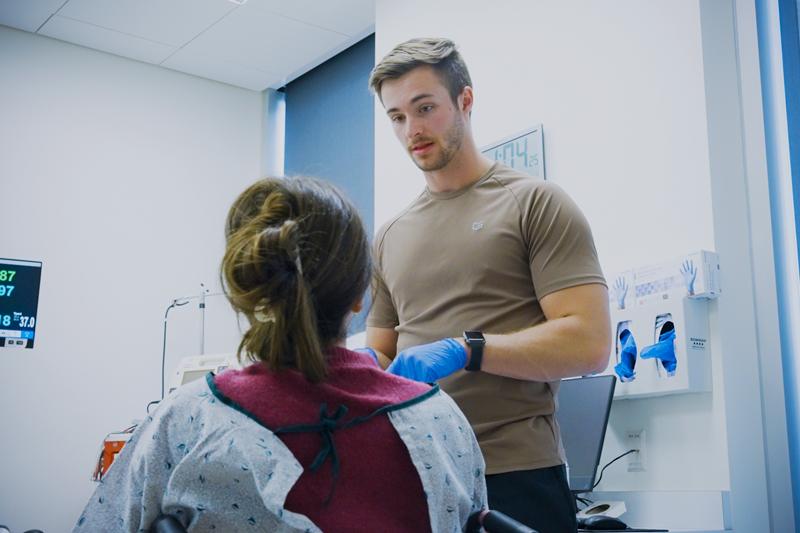
For many students pursuing a Doctor of Physical Therapy (DPT) degree, the journey to becoming a physical therapist begins with a desire to help people return to the activities that matter most in their lives. For Tufts University DPT alum Noah Leaf, DPT25, that passion led him to the Tufts hybrid DPT program in Phoenix, where he developed the clinical knowledge, independence, and hands-on skills needed to launch his career.
Through the program’s accelerated hybrid format, Leaf balanced independent learning with immersive in-person labs and close faculty mentorship. His experience demonstrates how the Tufts DPT program prepares students not only to succeed on the NPTE and enter clinical practice, but also to pursue meaningful careers serving diverse communities.
In this Q&A, Leaf reflects on his experience in the Tufts DPT-Phoenix program, the impact of hybrid learning and clinical immersions, and how his education prepared him for his current role serving Alaska Native and American Indian communities.
What inspired you to pursue a career in physical therapy, and what led you to choose the Tufts DPT-Phoenix program?
"I learned what exactly Physical Therapy is during my undergraduate program and it immediately piqued my interest. A profession where I get to learn about people and what matters to them, investigate what it is that is keeping them from doing what they would like to do, and being the person to help them achieve or return to the places and activities that matter to them sounds like the best job in the world, and that’s physical therapy! I chose Tufts because I discovered that when there are topics that are very interesting to me I can learn very well independently, and Tufts seemed like it had exactly the right structure for me to learn well as well as exercise autonomy in how, where, and when exactly I learn best."
How did the hybrid, accelerated structure of the Tufts DPT program support your goals, and what was your overall experience like as a student?
"The hybrid portion of Tufts program immediately interested me. During COVID I learned that I can study from a distance very well, and I learned about myself when I study best and when I need breaks, and the hybrid structure that Tufts has allowed me to exercise my individual learning preferences. The accelerated part of Tufts is difficult, there’s no other way to put it. From day one, the expectations are high. However the expectations were not placed on me and then left for me alone to handle, the professors have consistent student hours, timer questions during live sessions, and even teaching assistants from prior cohorts that provide further learning opportunities. There are times when the weight of being in an accelerated program is greater than others, but overall I found it to be a difficult but manageable pace."
Were there specific courses, clinical experiences, or moments at Tufts that played a key role in shaping your professional identity as a physical therapist?
"During anatomy in Semester one Dr. Wooten laid such a solid foundation and emphasized so greatly that the more we take away from this class the better we will understand concepts further on in the program. This really helped me understand that I could have the greatest professors in the world (which I did at Tufts!) but I needed to be responsible for my own learning. Clinical instructors re-iterated this in their own way, all of them communicated that I am their student but they are going to let me operate very independently and they will support me directly at some points and at other times indirectly by asking me questions that made me think about my clinical decision making. As far as clinical practice, the part of the curriculum at Tufts that most directly impacted the work I do today was the in person lab immersions. In a hybrid program like Tufts, you have to hold yourself personally accountable to learn the hands on skills. Every opportunity is provided to you, and the more effort you put into it, particularly at the lab immersions, the more you will get out of it."
What was the transition like from graduating the Tufts DPT program to entering clinical practice?
"In school, the details really matter. It is really important to sharpen your thought process because on test questions, particularly questions on the NPTE, knowing the details is what it’s all about. In clinical practice, the details still matter, but you aren’t thinking about them just for details sake, you are considering the patient in front of you. When documenting I will consider what all I just really did with a patient, and there are things I notice I could’ve done better or that would have been more appropriate, and I don’t think that would happen if I didn’t pay attention to the details during school. There is a lot of gray area in physical therapy, but knowing the specifics has helped keep me anchored in examination and treatment processes particularly with complex patients."
What motivated your move from Arizona to Alaska, and how did the opportunity to work with the Kenaitze Indian Tribe come about?
"My wife and I had been planning on staying in Arizona post-graduation. I had a position lined up in Phoenix that I was really excited about, but we both had gone back and forth on moving back home to Alaska.While I was studying for boards, the Kenaitze Indian Tribe returned a call regarding an application I had put in months prior. The process was very fast paced but between the time I took the NPTE and got the results (so the span of about a week), I flew up to Alaska and received a job offer from the Kenaitze Indian Tribe at the Dena’ina Wellness Center in Kenai, Alaska."
Can you describe your current role in Kenai and the patient populations you serve?
"I am one of four Physical Therapists at the Dena’ina Wellness Center in Kenai, Alaska serving Alaska Native and American Indian tribal members on the Kenai Peninsula. The majority of patients are orthopedic in nature, experiencing chronic pain, surgery, or acute injury. A small percentage of my caseload is pediatric with most of those patients having a gross motor delay, and a similar portion of my caseload requires management of a neurological or cardiopulmonary condition. I also provide ergonomic services to other staff members of the Tribe across all workplaces and professions."
How has your Tufts education influenced your approach to patient care in this new clinical and cultural setting?
"Tufts provided many opportunities to develop both cultural competence and cultural humility. Though I grew up in Kenai, there is a lot about the AI/AN environment as well as Indian Health Services that I am still learning. As far as confidence entering a new clinical setting, Tufts prepared me as well as I could’ve imagined regarding both hands on skills as well as clinical knowledge. Questions were always answered thoroughly, and the professors provided such great conversation to discuss clinical practice, cultural settings, professional behavior, and all kids of things to help us succeed wherever we found ourselves."
What advice would you offer to current or prospective Tufts DPT students who are interested in nontraditional or mission-driven career paths?
"To prospective students, if you want to better yourself through a program that offers unmatched autonomy in your learning journey to become a Physical Therapist, Tufts is the program for you. I would encourage you to evaluate yourself and determine if you are ready to hold yourself accountable to the process, because I believe that’s one of the most important traits to succeed in a program like Tufts. To current students, enjoy the process, don’t take it too seriously, don’t leave anything on the table. Once you see the “PASSED” screen on the other side of the NPTE, it will all be worth it."
Want to hear more?
Related Links:
Tufts DPT Program Information
Apply to Tufts DPT-PHX
Request Information
Watch Video